A Lemma on Factoring
And a dilemma on making further use of it

Gary Miller is a Professor of Computer Science at Carnegie Mellon University. He is best known for the Miller-Rabin primality test, which was cited in awarding him the 2003 ACM Paris Kanellakis Award along with Michael Rabin, Robert Solovay, and Volker Strassen. He has, however, been active in many other areas. His publications page has the best database functionality of any I know, and needs it.
Today Ken and I wish to talk about a result that evolved from Gary’s classic 1975 primality-testing paper into Section 2 of an equally classic 1986 joint work with Eric Bach and Jeffrey Shallit on factoring. That paper also ascribes it to Douglas L. Long. We wonder if it can be evolved further.
I still recall the night I heard about Gary’s great result. This was before e-mail and of course the Internet. Social media meant phone calls or even letters. David Dobkin had heard about the result, and we were both at a party on a Saturday night when he grabbed me, and took me aside—the party was loud–and told me about Gary’s theorem on primality testing. I was immediately excited, a breakthrough? Certainly if one believes the Extended Riemann Hypothesis as used in the paper to get an 


Last year, Gary was hailed here for a “theoretical breakthrough…with enormous practical potential” on the solving of linear systems of equations from symmetric diagonally dominant matrices. The paper is joint with Ioannis Koutis and Richard Peng, and appeared at FOCS 2010. The CMU press release notes that Gaussian elimination “was first published by Chinese mathematicians 2,000 years ago”—a case of “everything being named after Gauss.”
The Result
We will state the result only for the case 

The related significance of the result is expressed by the title of the referenced paper by Long: “Random equivalence of factorization and computation of orders.” This is the equivalence used implicitly in Peter Shor’s famous paper on factoring by quantum computers. We have not been able to trace Long’s paper beyond the “to appear” citations. In any event, Shor cites the 1976 journal version of Miller’s paper for this equivalence.
Lemma 1 Suppose we are given integers
and
such that
where
and
are odd primes, and
. Then we can factor
The proof below is a slight simplification of the one in Section 2 of the 1986 paper, but still strikes us as not the proof from The Book. We thought you might like looking at it.
Factoring Via GCD
There really is one theme that is used over and over in most methods of factoring: try to construct an integer 


Let’s look at how this strategy factors 

Define 


and

are odd numbers. The rationale for these definitions is the following two lemmas:
Lemma 2 There is a randomized algorithm
that factors
is true.
Proof. Assume that 





is true only at most half the time. Since 


Lemma 3 There is a randomized algorithm
that factors
is true.
Proof. Assume that 


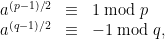
by the famous Euler criterion. The last step is to note that by definition of
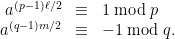
Putting This Together
Recall that we start with an
Our goal is to find 


Let’s prove that. Initially 


So suppose neither divides

Necessarily 

Open Problems
Is there a way, given knowledge of 
[fixed AKS names, clarified last eqn in Lemma 3, fixed CMU link]


The names should be Neeraj Kayal and Nitin Saxena.
Whoops! Tushar Saxena is someone I knew (of) while he was at Albany. Thanks. Meanwhile, I was occupied with Mac Firefox momentarily displaying the raw LaTeX code rather than rendering it, but it is now OK again.
To me and
and  may be ambiguous but most intuitively parses like
  and
and  . I assume you mean what would be clearer as
  and
and  .
.
Ørjan Johansen,
Good point. We should have fixed that. Of course it only divide by 2. Thanks.
Fixed—thanks. Actually, here’s a weird “excuse” while tired: I was trying to work out whether only one evaluation of B^*(r_{k-1},M) might be needed in the algorithm as originally written, so mentally I was seeing powers of 2 in those denominators…
Very nice post.
But I can’t resist: Joel David Hamkins has, in my biased opinion, a slightly better publication page.
By “better” I only mean the database functionality, of course.
“But I can’t resist: Joel David Hamkins has, in my biased opinion, a slightly better publication page.”
Not bad. But nobody beats Neal Young:
http://www.cs.ucr.edu/~neal/publications
“Last year, Gary was hailed here”
The link at the word “here” seems to be broken.
Fixed—the “http://” was missing. Thanks. Alternate, perhaps more permanent, link in the CMU archives here.
When I was an undergrad in the 70s Miller was working on graph embedding, and had some nice papers on efficient ways to embed planar graphs. At the time, I got the impression he was moving in the direction of graph isomorphism, but apparently he changed course interestingly.
I don’t know why the period r got by quantum computing can be divided by p-1. Could you say more about it? I can only infer that r divides (p-1)(q-1).